

The great epic Mahabharat depicts the history of Pandavas and Kauravas, the descendents of King Bharat; it includes the Kurukshetra war and most importantly Bhagwad Gita. Bhagwad Gita is a part of Mahabharat and the holy scripture originated 5000 years ago which was compiled by Maharishi Ved Vyasa, the great rishi. He was the son of rishi Parashar and has to his credit of compiling the longest epic titled Mahabharat. This epic was compiled keeping in mind that basic spiritual knowledge should reach every segment of the society be it the uneducated, women or the deprived ones, hence it is so vast and lengthy. And in addition to Mahabharat, Maharishi Ved Vyasa also composed 18 puranas (legendary stories), Brahma sutra and most notably Shrimad Bhagwad Gita. Shrimad Bhagwad Gita is a song divine, the nectar of God and has endowed in it the eternal knowledge or shashwat gyan of immortality of our Spirit.
The Pandavas and Kauravas were cousin brothers and Kurukshetra became the battle ground of wicked Kauravas and the pious Pandavas over inheritance. They were the warring clans because of Duryodhana the eldest Kaurava, who vehemently declined to transfer the legitimate kingdom to scion Yudhisthir, the eldest of all the Pandava brothers. It was this fierce war that Arjuna refused to fight against his own kith and kin and instead accepted living as an ascetic. However, Lord Krishna motivated him during that time and advocated not be averse to face the formidable situation as this was his duty, his dharma. And afterwards, being pleased with his obedience and devotion, Lord Krishna also revealed to him his divine form. Surprisingly, Bhagwad Gita is the only holy scripture that was born during the time of a war while all other great scriptures have originated in times of peace.
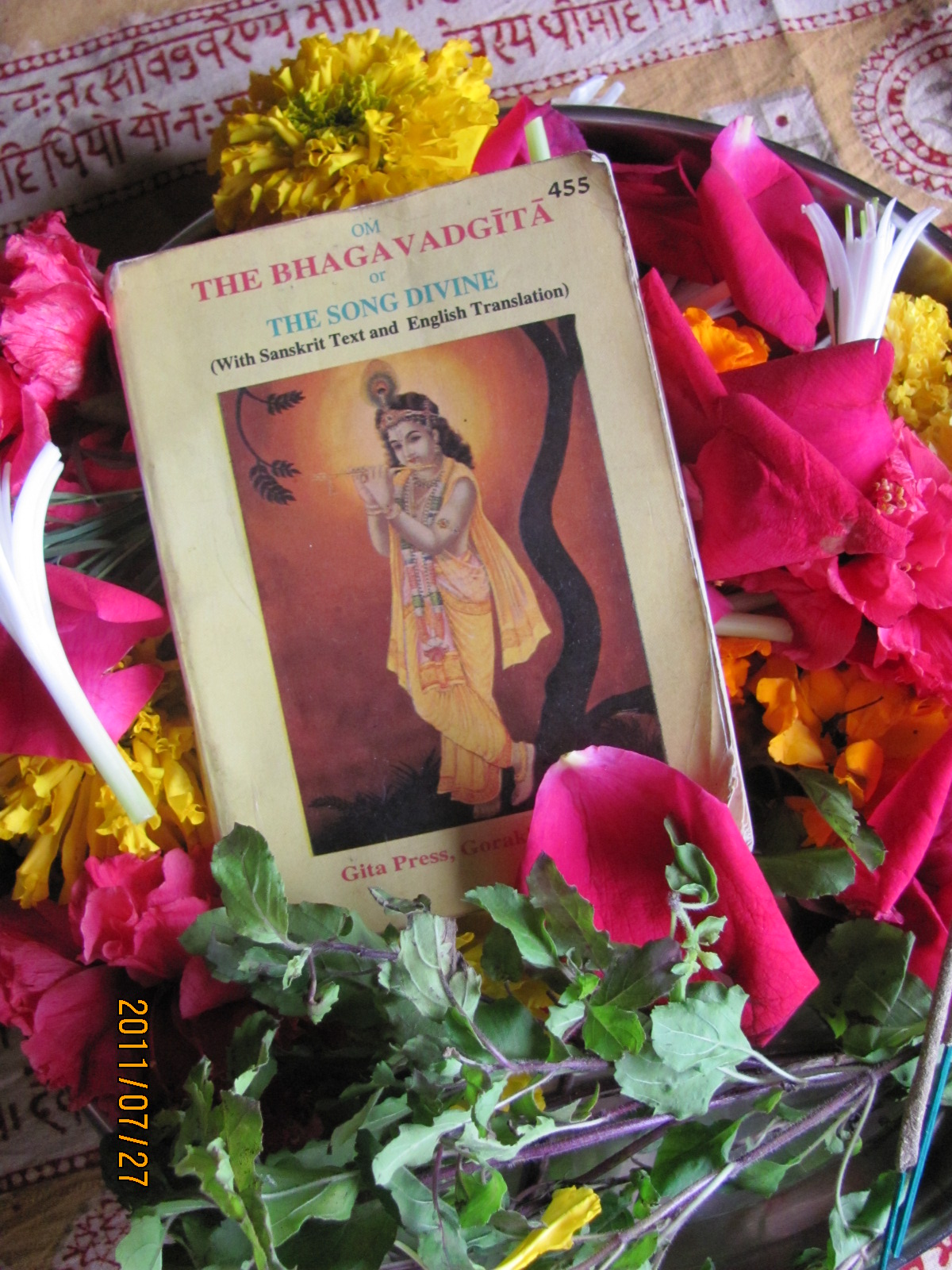
Shrimad Bhagwad Gita is the ultimate statement of spiritual knowledge comprising of 700 verses of Sanskrit verses which reveal the essence of ancient Vedantic philosophy. It is a holy science of Vedantic knowledge comprising of Hindu philosophy of indestructible Atman. It is an Upanishad in its own right and is a concise guide to Hindu theology. It has an universal appeal because it confers upon us the answers to our self enquiry on our quest and journey to self realizatioin.
It is also called ‘Geetopanishad’, song of Upanishad. What’s more, some even call it ‘Mokshashastra,’ the scripture of liberation, since it contains exact knowledge of Atma, Parmatma, yoga, karma, reincarnation, duties of a seeker in times of personal crises and a lot more.

With god’s grace, I was fortunate to have made a visit to the pilgrimage city Alandi, in Maharashtra in April 2006. It is the samadhi place of saint Gyaneshwar who has authored the Marathi commentary on the Bhagwad Gita. However, I have read just some part of it which pertained to why and how should one be in control of one’s senses and mind in order to attain calmness and enduring peace. Controlling the restless mind and eager senses is the duty of the sadhak, it said. The verses are metrical and beautiful and has profound richness endowed in it.
Dear friends, now we will move on to the lesson of our day. But before that let me request you to kindly read the two parts of this post together to get a better understanding on the discussion that is going on since quite some time. This blog is a worldwide forum and as people from all over are getting interested slowly in the ancient knowledge of self realization, it is suggested that you read both these posts a few times more. And if possible also run through a few pages of Bhagwad Gita to get to the depth of Vedantic philosophy, and chapter 2 in particular.
And here I need to quote and go back to the last article-‘Why is peace so essential for a seeker?-I.
“How should one read the holy book Bhagwad Gita?
First and foremost we must invoke the spirit of Lord Krishna and his chief disciple Arjuna, both.
Why?
Lord Krishna will impart the eternal knowledge of Self while the all pervading Spirit of Arjuna will teach us how to be an ideal disciple of the Spiritual Master and mentor. And how to balance one’s inner spiritual life with the outer physical and material world consisting of our family, relatives, society, profession and others areas; that is to say that the inner world and the outer world must meet and converge on a positive note. We need to learn to balance both for our happiness, emotional security and sustained peace of mind.”

Once the consciousness of Arjuna incorporates with that of Lord Krishna and becomes one, they both have one thought or sankalpa and there is no demarcation and difference between the disciple and the Master, the individuality of Arjuna disappears. After this, there is resonance in their intention and thought as they are in unison with the all pervading God and they both can impart spiritual knowledge to their respective disciples.
Arjuna is an epitome of an ideal disciple in Indian history who had complete control over his senses and mind. He was an ideal yogi, disciple, son, husband, father, archer, marksman and a compassionate and just human being. He was equally skilled in yogic practices as he was in worldly affairs. He struck a balance between both his worlds and delivered more than satisfactory results as the situation at that time demanded of him. Like him, we too need to have knowledge of Self and the world alike.
One can’t realize God until the environment that one lives in is calm and peaceful steadily. If there are tiffs and tensions in relationships or if there are financial problems at home, the mind cannot be in a peaceful state obviously. So invoke the spirit of Arjuna to bring about a change in attitude by not neglecting the assigned duties for personal growth and development, financial security, family’s progress, cordial relations with society and family. They all are important.
In the last post it was mentioned that peace is a prequalification to know God. It is true that we must shed egoism, frustration, earthly desires etc. so that the mind is in tranquil state and we do not create wrongful thought patterns in our consciousness. The frittered mind breaks the unity with God hence the mind’s attention and focus should be extended as much as one can. After practicing controlling the wavering mind like Arjuna, the seeker faces yet another major problem- that of offensive attacks from other people without one’s own fault or mistaken action and that too quite often!
There will always be enough people who will be malicious and wicked and will target you even though you will wish good for them always. You may be too preoccupied with your routine tasks and spiritual practices yet their snipes and verbal attacks may shrink your joyous temperament. What should one do in such a case?? How can we try to return to equilibrium?
First of all remember this -Do not lose your peace…. And
- Have minimum contact and talk as less as possible with such troubling people.
- Do not do anything that will provoke them and in return they might harm or play a mischief with you more than ever before.
- When you meditate, pray for them that their nature should be more kind, sweet and caring.
- Listen more and talk less with such nasty people.
- When they harm you, tell God about it during the time of your prayers. God will send help to you in some form and will also give you solutions and answers to your problems in that relationship.
- When you will meditate, their face will re -appear in front of you. Ignore it and bring back your mind to your point of concentration.
How to seek and maintain peace while living here, in this world?
At this juncture I recall a very interesting incident between Arjuna and his wife Draupadi.
When in exile after Varnavata mishap, the mother of the Pandavas had taught them to share everything that they got as alms equally amongst themselves. Upon returning home with Draupadi whom Arjun won in swayamvar, he addresses his mother by saying, “Look mother what we have got in alms today.” Unmindful of what Arjuna was referring to, she unassumingly asked the brothers to share whatever they got. And in order to obey the order of their mother all five Pandavas accepted Draupadi as their wives. Later Draupadi told Arjun, “You won me as your wife in the contest held at my father’s palace. Although now I am to be shared equally with all your brothers, my mind will always be with you, although physically I may be with other brothers.” Such should be one’s mind- always focused on God though physically we may live anywhere in this world.
Like Draupadi, who was in soul and heart of Arjun but outwardly she belonged to all other Pandavas, in the same way we should be of God although we may live in this world and we may have to live with all sorts of people and face many kinds of tough situations. The mind should be stabilized, steady and ever fixed on omnipresent God to retain peace and equanimity. How?
- Always remember to recall God and your gurus for help in times of distress and difficulties. Peace shall return. You will find solutions to your spiritual as well as worldly problems; seek their guidance and supervision to find your way out of darkness and difficulties. Meditate more often.
- While doing normal daily activities cut off for a while from the existing scenario and gather peaceful vibes by recalling some tranquil moments of your meditations or peaceful places that you have visited.
- Practice composure every day, even till the last day of your life as there is no substitute for peace in our life.
- Listen well and attentively to others. Give a gap between the words that stream in your ears and the words that fall out. Increase that gap. Although this might sound easy but the mind is forceful and often gets out of control. One needs long practice in controlling the flow of words and the choice of words also that one may use while speaking.
- Learn and practice the art of speaking. Talk less; speak a small number of words which may meet your requirements.
- Save mental energy. Practice silence and peace; speak still fewer words and live in peace. It is essential!!!
Narayan Narayan Hari Hari Prabhu Narayan Narayan Hari Hari
Hari Om! Shanti, Shanti, Shanti Om!

In Alandi, in Apr 2006